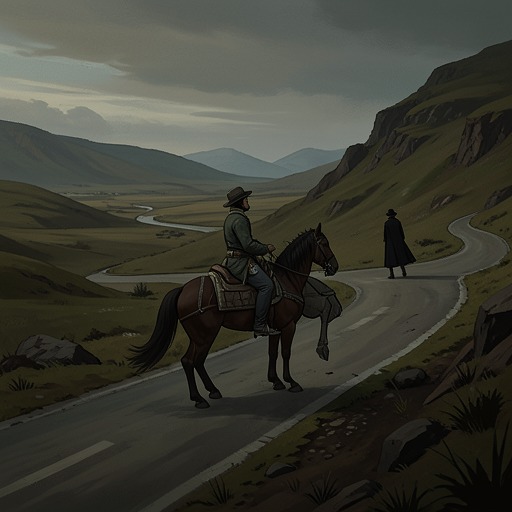
The pursuit of Milady to Armentières
The Three MusketeersThe pursuit of Milady to Armentières is the immediate continuation of Constance Bonacieux’s death: a movement from stunned grief to deliberate pursuit. D'Artagnan and his three friends have arrived too late to save her, while Lord de Winter, Milady’s brother-in-law, has followed her across the road from Portsmouth through Boulogne, St. Omer, and Lilliers. Their common objective is not merely to find a fugitive but to prevent the woman responsible for so much suffering from escaping the consequences of her actions.
The Pursuit Begins
Lord de Winter identifies himself to d'Artagnan, Athos, Porthos, and Aramis as the brother-in-law of Milady and explains that he has been following her for hours. He left Portsmouth five hours after her, reached Boulogne three hours later than she did, missed her by twenty minutes at St. Omer, and lost her trail at Lilliers. His exhausted horse could not keep pace with the friends, and when he finally encounters them, he recognizes that their diligence has also failed: they have reached the scene after Constance’s death.
The travelers stop at an inn on the outskirts of Bethune, bringing their lackeys and horses with them. D'Artagnan immediately asks whether they should continue after Milady, but Athos postpones the answer. His consolation of d'Artagnan is severe and paternal rather than sentimental: he draws his devastated friend away while recognizing that grief must first be endured before action can be safely organized. The pursuit therefore begins in an atmosphere where love, death, and vengeance are inseparable.
Athos Reconstructs the Route
Athos’s despair hardens into concentrated purpose. He withdraws to his chamber, obtains a map of the province, and studies the roads leading from Bethune to Armentières. Four routes are available, so he summons Planchet, Grimaud, Bazin, and Mousqueton and assigns each man a separate road. They are ordered to leave at daybreak and meet at eleven o’clock; if Milady’s retreat is discovered, three are to remain on guard while the fourth returns to Bethune to guide Athos and the other three friends.
The use of the lackeys is a calculated choice rather than a practical afterthought. Athos has observed that servants, because they ask questions without attracting the same suspicion as their masters, receive more sympathy and information. Milady knows the four gentlemen but does not know their lackeys, whereas the lackeys know her. The pursuit thus reverses the usual hierarchy of the adventure: the servants’ anonymity becomes an investigative advantage, and loyalty is converted into a disciplined intelligence network.
Athos also follows the evidence personally. At the convent, while the others attend the service surrounding Constance’s body, he asks to be led into the garden. He follows Milady’s small footprints across the sand to the gate opening into the forest and then into the woods. The road curves around the forest, confirming his suspicion that the carriage vanished by that route. Bloodstains mark the way, apparently coming from the wounded courier who accompanied the carriage or from one of the horses. After three-quarters of a league, near Festubert, a larger stain and trampled ground reveal where horses halted; behind the disturbed earth, the same small footprints show that Milady left the forest and entered the carriage.
Planchet’s Investigation
Planchet extends Athos’s discovery beyond the physical trail. At Festubert, he learns at an inn that, on the previous evening at half-past eight, a wounded man traveling with a woman in a post-chaise had been forced to stop because he could go no farther. The incident had been attributed to robbers who stopped the chaise in the forest. The man remained in the village, but the woman obtained fresh horses and continued alone. This testimony clarifies both the interruption of the journey and Milady’s ability to separate herself from the injured man without abandoning her escape.
Planchet finds the postillion who drove the carriage and learns that the woman was taken as far as Fromelles. From there she set out for Armentières. Taking a crossroad, Planchet reaches the town by seven in the morning, ahead of the main party. The pursuit has now advanced from rumor, to tracks and blood, to named stages and a verified vehicle route.
At Armentières there is only one tavern, the Post. Planchet disguises his purpose by presenting himself as a lackey seeking employment. Within ten minutes of speaking with the tavern’s inhabitants, he discovers that a woman arrived alone at about eleven o’clock the previous night, took a room, summoned the innkeeper, and announced that she intended to remain for some time in the neighborhood. The information establishes Milady’s destination and suggests that she believes the immediate danger has passed. Planchet then returns to the rendezvous, places the other lackeys as sentinels at every outlet of the hotel, and brings Athos the news.
From Mourning to Vengeance
The event’s central reversal is a change in the value attached to delay. At first, delay means failure: the friends arrive after Constance is dead, and Lord de Winter’s pursuit has repeatedly missed Milady by hours or minutes. Under Athos’s direction, however, the same failed pursuit becomes a source of knowledge. Every lost encounter leaves a measurable trace—time, road, bloodstain, hoofmark, footprint, post-chaise, and innkeeper’s report. The fugitives’ apparent advantage is gradually converted into a route that can be mapped and closed.
Athos’s conduct also gives the pursuit a moral and ritual dimension. He is faithful to the promise and responsibility he has assumed, and at the convent he leaves the public scene of mourning to follow the physical signs of Milady’s departure. The corpse of Constance remains the emotional center of the episode, but the road through the forest becomes its judicial extension. The blood on the road, the trampled ground near Festubert, and the woman’s isolated journey toward Armentières make vengeance appear as an investigation grounded in material evidence rather than an unexamined impulse.
The chase belongs to a wider world in which private action is continually shaped by political and military power. The period is marked by conflict among nobles, the king, the cardinal, Spain, Huguenots, robbers, and other threats; citizens are accustomed to taking up arms amid recurring panic. The same instability permits Milady to move across jurisdictions and roads, but it also gives Athos’s small coalition room to act beyond ordinary legal procedure. The pursuit is therefore both a personal vendetta and an improvised counter-authority formed by gentlemen, a nobleman, and servants.
Narrative Function and Outcome
The pursuit does not end at Armentières; it ends by making the next confrontation unavoidable. Once Planchet has located Milady and the lackeys have sealed the tavern’s exits, her flight has become confinement in preparation. The narrative shifts from uncertainty about where she has gone to certainty about where she can be found. This is the decisive consequence of the episode: Milady is no longer an elusive presence scattered across rumors and memories but a woman fixed at a particular inn in Armentières.
The episode also gathers several forms of unreliable or incomplete knowledge into a single chain. Lord de Winter’s testimony supplies the chronology of the chase; Athos reads the landscape; Planchet extracts local information while concealing his identity. Each account is partial, but the evidence converges. The reader is not given a single omniscient explanation of Milady’s movement; instead, the route is reconstructed through separate observers whose findings correct and complete one another.
That method prepares the moral and dramatic logic of the scenes that follow. Milady’s own accounts of persecution and betrayal have already shown how power can be disguised through narrative, while the executioner of Lille’s later testimony will expose the history behind her marked identity. Against such stories, Athos’s pursuit relies on what cannot easily plead or persuade: geography, blood, tracks, times, and witnesses. The road to Armentières thus turns a woman’s escape into a legible pattern and carries the four friends, Lord de Winter, and their servants toward a private trial in which vengeance seeks the force of justice.